
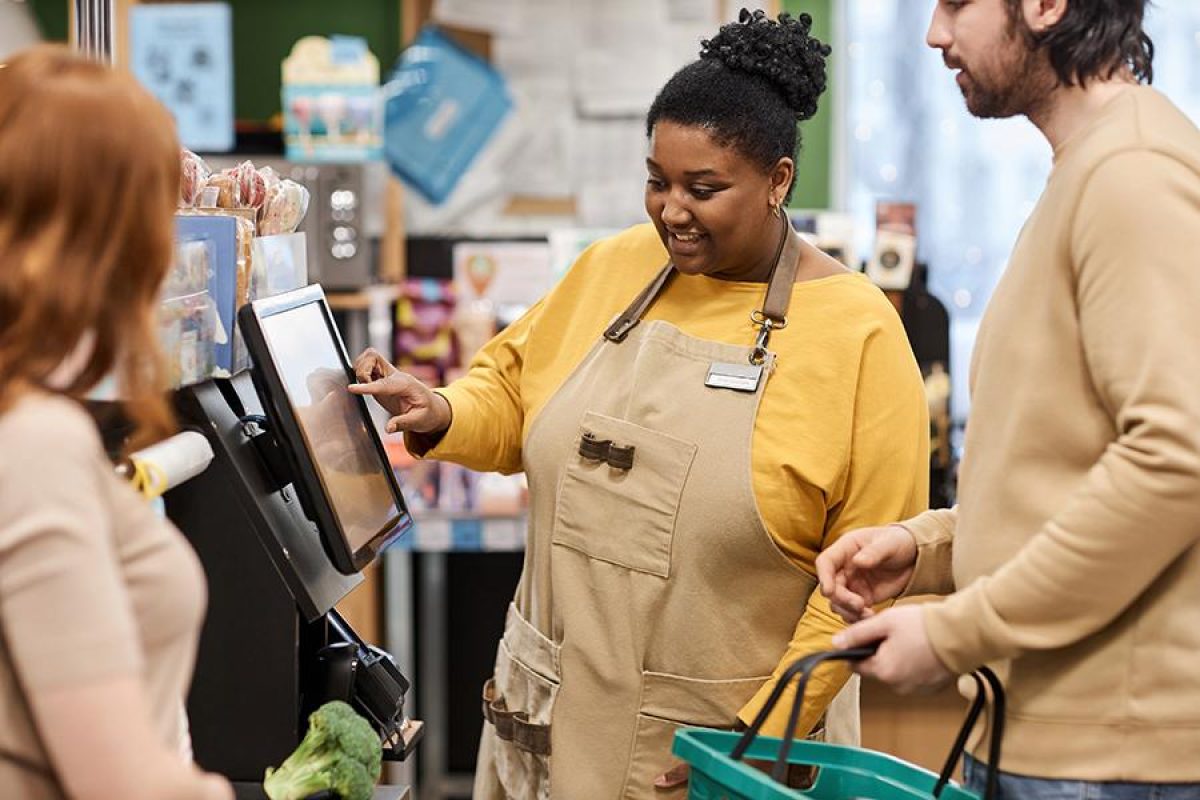
Retail and grocery self-service trends in 2026 include self-checkout, perimeter self-service kiosks, loyalty and engagement, endless aisle solutions, and self-service order pickup. These technologies give shoppers more control while helping retailers and grocers reduce wait times, improve operational efficiency, increase engagement, and support different customer journeys. Successful implementation requires clearly defined goals, hardware-agnostic software, purpose-built hardware, strong security and loss prevention, and employees who can assist customers when needed. The right combination of software and hardware allows retailers to create self-service experiences that fit their unique operations and customer needs.
In the not-so-distant past, grocers had few self-service solution options. However, in 2026, grocery self-checkout and retail self-service solutions are more flexible, accessible, and adaptable to a range of use cases. Grocers are implementing these solutions in innovative ways to keep lines short, give shoppers more control over their shopping experiences, and increase customer satisfaction.
Grocery and Retail Self-Service Trends Gaining Momentum
Staying competitive requires keeping up with technological advancements and consumer expectations. Grocers are deploying new solutions and optimizing processes in these five areas:
Self-Checkout
LOC’s 2026 Exploring Grocery Technology Trends Survey revealed that 59% of North American grocers offer self-checkout. Grocers without self-checkout are deploying these systems to continue to compete on customer experience. However, grocers and retailers with existing systems are updating them to give customers a wider range of payment choices at self-checkouts, such as tap-to-pay and biometric payments.
Retailers and grocers will see the greatest user adoption and customer satisfaction by implementing total solutions. Integrated tools such as scales and barcode scanners allow customers to check out confidently without the help of a cashier or sales associate. They will also keep losses at the retail or grocery self-checkout low with a smart system that uses cameras or sensors to ensure that customers scan all items at the correct prices. Diebold Nixdorf reports that AI-powered loss prevention has allowed merchants to achieve up to 80% loss rectification.
Perimeter Self-Service
Perimeter self-service is one of the fastest-growing trends. Kiosk Industry reports that the U.S. self-ordering kiosk market has grown from $202.6 million in 2019 to $383.4 million in 2025, a phenomenal 22.6% CAGR.
The results of perimeter self-service are driving adoption. By placing their orders on a kiosk, customers can communicate precisely what they want and get updates on their orders . Retailers and grocers benefit from greater accuracy, less waste, and more efficiency. Furthermore, according to McGraw Hill, consumers spend up to 40% more when they take their time and order independently.
Loyalty and Engagement
The best grocery and retail self-service solutions deliver reliable, customer-friendly ordering or experiences,but they can do much more. Self-service solutions in high-traffic areas can attract customers with eye-catching images or videos, display ads, and promote events. Additionally, grocery and retail self-checkout can give shoppers an easy way to join a loyalty program and begin earning rewards. Large stores can also deploy self-service solutions for wayfinding to help customers find what they’re looking for down to department and aisle.
Endless Aisle
Kiosks are always on, so they can always help customers find what they need, even if it isn’t in stock at the local store. A growing self-service trend is to create “endless aisle” options that allow customers to browse the entire inventory, order, pay, and arrange for in-store pickup or home delivery. Giving shoppers access to information can keep revenues in the store, rather than losing sales (and possibly a customer) to a competitor.
Order Pickup
Self-service solutions can give ecommerce customers a convenient way to notify store employees that they’ve arrived for their buy online, pickup in store (BOPIS) orders. They can scan a QR code or enter an order number for prompt service without requiring them to download an app or stand in line for assistance.
Steps to a Successful Self-Service Implementation
Deploying retail self-checkout or self-service technology to give consumers more autonomy during their shopping journeys is a simple concept, but it’s tricky to implement successfully.
Define Goals for the Implementation
Merchants must deploy retail and grocery self-checkout or self-service as part of a well-planned strategy that begins with defining goals for the implementation, which can vary. Retailers may have a goal of keeping lines shorter when store traffic increases or increasing customer engagement with digital solutions in-store. Another driver is to transition from assisted checkout to self-checkout during the labor shortage as Piggly Wiggly did. Deploying reliable self-checkouts solutions resulted in better customer experiences, leading to 48% utilization and decreasing the need for employees to help customers at the register.
To achieve their specific goals, merchants should work with an experienced provider with solutions that address the latest self-service trends in addition to their business goals.
Choose Hardware-Agnostic Software
The best approach to implementation is to choose hardware-agnostic software, so employees and customers use the same solution on self-service kiosks and self-checkout as they do on POS terminals and mobile devices. One software solution for all devices simplifies IT management and ensures consistent experiences for customers, regardless of how they engage.
Select Hardware with the Right Features
Hardware selection impacts how well the solution will help merchants reach their objectives. For example, a large, interactive touchscreen solution can more effectively engage consumers as they shop, while a grocery self-checkout will benefit more from a smaller screen that makes transactions and protects the customer’s privacy. Deploy the best-fit hardware for each application.
Prioritize Security
Retail and grocery self-checkout solutions must include robust security and fraud prevention. When customers don’t scan items, whether accidentally or intentionally, it negatively impacts the bottom line. Innovations are now available that allow merchants to overcome this challenge. For example, AI-powered machine learning solutions can protect merchants from shrinkage and losses at the self-checkout. Merchants also need to protect their investments by deploying solutions that monitor, secure, and update hardware to keep self-service solutions operational.
The Importance of Factoring Employees into Grocery and Retail Self-Service Strategies
While purpose-built grocery self-checkout and retail self-service solutions allow customers to complete transactions on their own, merchants should recognize that their employees are still key to providing the best experiences. Solution providers can’t anticipate every scenario that merchants and customers could encounter. Employees should be available as customers use self-service solutions to provide assistance. minimize losses, and ensure self-service solutions are operating correctly.
The best strategy is to identify employees who have the heart of a teacher who will help customers understand and embrace self-checkout. Those employees will also be best suited to make the most of opportunities for personal interactions that enhance in-store shopping experiences. However, grocers shouldn’t assign cashiers with the best scan productivity to self-checkout. It’s important to keep those employees in traditional lanes.
Differentiate Your Business with Your Unique Approach to Self-Service
Although deploying retail and grocery self-checkout and self-service options is a popular trend, it doesn’t mean that these solutions must operate the same way in every store. Merchants can create unique experiences with the right combination of software and hardware to enhance customer experiences and their brands.
Contact us to learn how to optimize self-service with flexible, hardware-agnostic software that enhances experiences, simplifies IT management, and enables deep visibility into store operations.





 English
  French
  Spanish